E-bikes are selling faster than ever.
Millions of riders are ditching cars, slashing commuting costs, and discovering that cycling doesn’t have to mean arriving at work sweaty.
But hidden in the fine print of your homeowners or renters insurance policy is a clause that could turn a battery fire into a financial catastrophe and most buyers have no idea it exists.
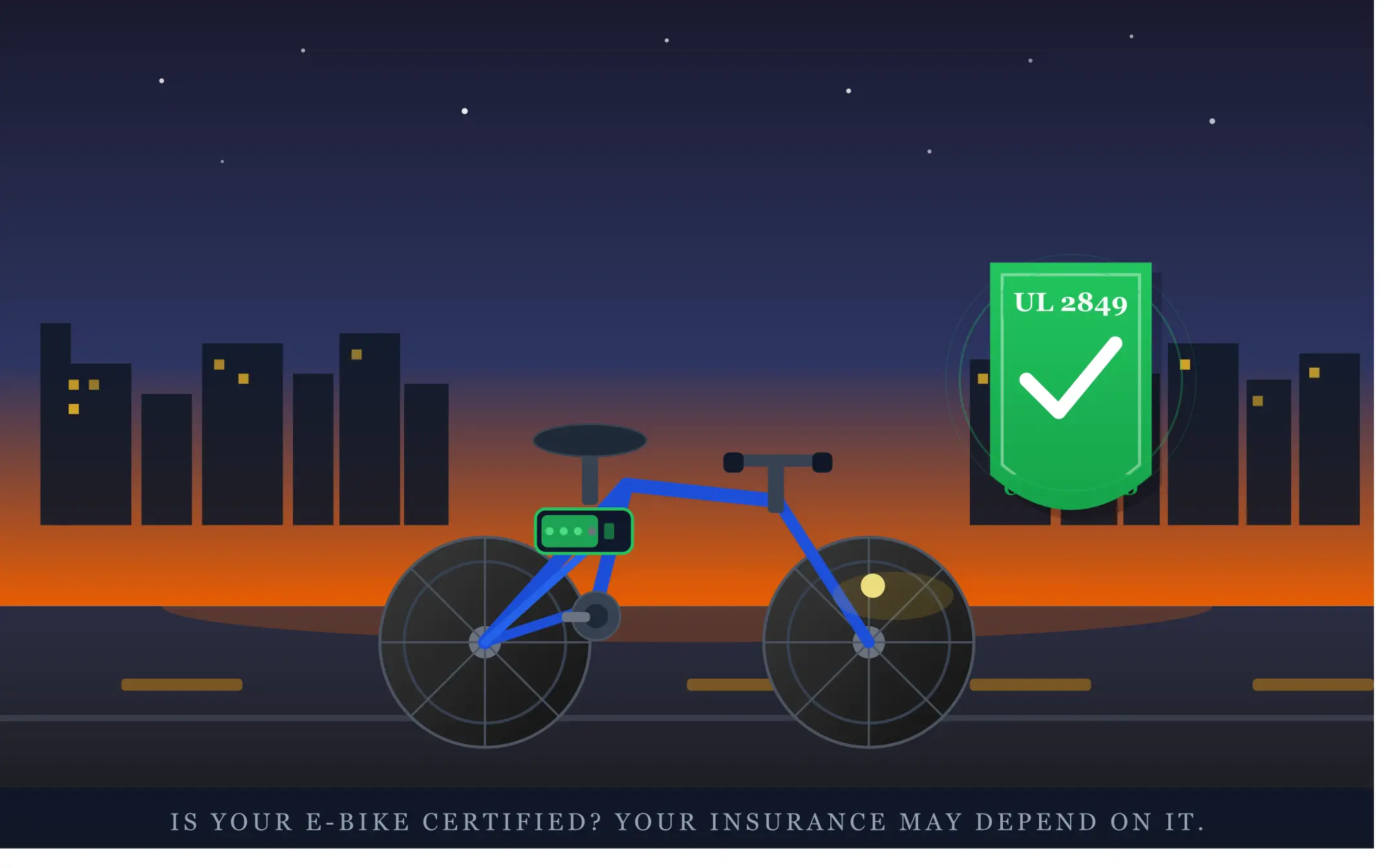
The certification is called UL 2849. You’ve probably never heard of it. By the time you finish reading this, you’ll never forget it.
What Happened in New Jersey Changed Everything
In mid-2025, two homes in New Jersey were destroyed when a charging e-bike battery sparked a fire.
According to the FDNY, these fires behave differently from most household fires. They don’t just ignite, they explode.
Between 2021 and 2024, New York City alone recorded up to 540 e-bike and e-scooter fires, resulting in hundreds of injuries and nearly 30 deaths.
When the smoke cleared in those New Jersey homes, many of those homeowners faced a second disaster: their insurance company denied the claim.
Why? Because of a 47-word exclusion buried in their policy.
The Motorized Vehicle Loophole Most Riders Don’t Know About
Here’s what many insurers won’t tell you upfront: because e-bikes have a motor, many insurance carriers legally classify them as “motorized land vehicles.” The moment your policy includes a standard motorized vehicle exclusion clause; and most do, your insurer can deny a theft claim, damage claim, or even a fire claim, arguing the e-bike falls outside standard homeowners coverage.
Even when that exclusion doesn’t apply, insurers can deny fire-related claims on a second ground: negligence.
If your e-bike’s battery causes a fire and the insurer determines you used an unapproved charger, an uncertified aftermarket battery, or failed to follow the manufacturer’s safety guidelines, they can refuse to pay out. The burden of proof is on you to demonstrate that the fire wasn’t your fault.
Using an uncertified battery or charger gives them exactly the opening they need.
Also Read: The truth about an Ebike Range
So What Is UL 2849, and Why Does It Matter So Much?
UL 2849 is a comprehensive safety standard published by Underwriters Laboratories specifically for e-bike electrical systems. It doesn’t just test the battery in isolation. It evaluates how the battery, charger, motor, and controller interact under extreme stress, including overcharging scenarios, impact damage, and thermal conditions that can trigger a runaway reaction.
The standard was developed after years of alarming battery fires involving off-brand replacement batteries and uncertified chargers. The chemistry behind these fires is called thermal runaway: a chain reaction where a battery cell overheats, releases energy, heats adjacent cells, and rapidly escalates into an explosion-level event, often within minutes.
In December 2022, the U.S. Consumer Product Safety Commission (CPSC) issued letters to more than 2,000 businesses warning that failure to comply with UL 2849 could constitute an “unreasonable risk to consumers.”
Then in March 2023, New York City went further, passing a law that made it illegal to sell or distribute e-bikes that don’t meet UL 2849 certification requirements. California’s 2026 e-bike legislation includes similar battery safety provisions, and other states are expected to follow.
The Insurance Industry Is Now Paying Close Attention
The insurance world has been watching the fire statistics closely, and the response is tightening fast.
Homeowners associations, apartment complexes, and some insurance providers have begun requiring UL 2849 certification as a condition of indoor storage or coverage. Major retailers including Amazon and Walmart have also tightened listing requirements to exclude e-bikes without recognized safety certifications, squeezing uncertified budget imports out of the mainstream market.
Industry experts warn that the shift is accelerating: policies may increasingly require that your bike and its battery meet certified standards as an explicit condition of coverage, meaning claims involving uncertified or aftermarket batteries could be denied outright, not just disputed.
From an insurance perspective, owning a certified bike is a significant advantage. If a fire occurs, an insurer is far less likely to claim “negligence” if you can prove the device met federal and industry safety standards. Conversely, using uncertified or heavily modified battery packs; including popular “rebuilt” packs sold cheaply online, gives insurers a defensible reason to reject your claim.
The Risks Go Beyond Your Home
If your e-bike fire spreads to a neighbor’s property, a real scenario in apartment buildings and terraced houses, your liability coverage may be triggered. But if the insurer determines your uncertified setup was the cause, that liability protection could be voided, too. In densely built urban areas, where e-bikes are most popular, the stakes are even higher. London’s Fire Brigade recorded 165 e-bike and e-scooter fires in 2025 alone, with some requiring 80 firefighters to contain. The UK government launched a formal inquiry into “dangerous” e-bikes in April 2025, and home insurers are responding by imposing tighter storage restrictions.
One UK insurer, Bikmo, noted bluntly that the insurance industry’s knickers are “in a twist” over the risk, and that riders may increasingly find their e-bikes banned from indoor storage if certification requirements aren’t met.
How to Check If Your E-Bike Is Certified
This is where it gets practical. Here’s exactly what to look for:
1. Check the label on the bike and battery. A UL-certified e-bike will display the UL certification logo, wordmark, or name either on the product itself or in the packaging and documentation provided at the point of sale. If there’s no label, that’s a red flag.
2. Look at the product listing. Reputable brands display UL 2849 certification prominently because it represents a significant investment in testing. If it’s not mentioned anywhere in the spec sheet, ask the retailer directly.
3. Check the charger separately. Certification of the bike doesn’t automatically mean the charger is certified. The charger should match the manufacturer’s specifications. Using a third-party charger, even an apparently compatible one, can void both your warranty and your insurance claim.
4. Avoid secondhand batteries. Rebuilt or refurbished battery packs sold through online marketplaces are among the highest-risk items. The CPSC has specifically flagged certain uncertified battery packs after serious fires. These are very difficult to verify and carry a disproportionately high risk.
5. Keep your documentation. Maintain a digital “Safety Folder” with photos of the battery label, your original charger label, purchase receipts, and a copy of the UL 2849 certification for your specific model. If you ever need to file a claim, this documentation could be the difference between a full payout and a denial letter.
What If You Already Own an Uncertified E-Bike?
Don’t panic, but do act. A few steps can significantly reduce your risk and improve your position with insurers:
- Contact your insurer directly and ask whether your e-bike is explicitly covered under your current policy, and under what conditions claims could be denied.
- Consider a dedicated e-bike insurance policy. Specialist providers like Markel, BikeInsure, and Lemonade offer e-bike-specific coverage starting from around $100–$200 annually. Lemonade, for example, explicitly covers e-bike battery fires under its home and renters policies.
- Never charge overnight or unattended. The majority of catastrophic battery fires occur during charging. Charging in a room with a closed door, away from exits, dramatically increases the risk of entrapment.
- Follow the 20–80% rule. Fire investigators recommend keeping your battery between 20% and 80% charge for daily use. A fully charged battery at 100% has significantly more stored energy to release during a failure than one at 50%.
- Store your e-bike away from exits. If a battery ignites, a bike blocking a hallway or door can prevent escape. Keep exits clear at all times.
The Bottom Line: One Label Can Protect Everything
The e-bike market is growing rapidly and the bikes are genuinely getting safer. But the gap between certified and uncertified products is still enormous. The consequences of buying on the wrong side of that gap extend far beyond your bike.
A UL 2849 label doesn’t guarantee nothing will ever go wrong. But it dramatically reduces the risk of a fire, and perhaps more importantly for many owners, it dramatically reduces the risk of finding yourself holding a denied insurance claim while standing in the ruins of your home.
Before you buy, check for the certification. Before you replace a charger or battery, make sure it’s approved. And before you assume your homeowners policy covers your ride, read the fine print.
Because in 2026, your e-bike might be the best investment you make this year, or the one that costs you everything.