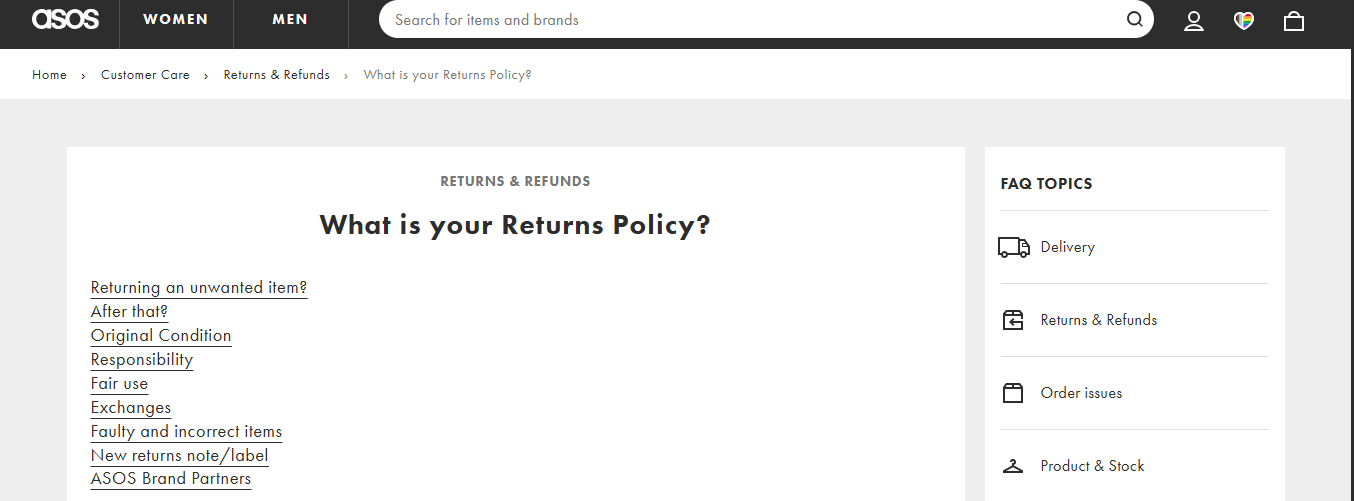
Online shopping has trained most of us into a particular habit. Order three sizes of the same top, keep the one that actually fits, send the other two back without a second thought.
ASOS practically built its early reputation on making that habit painless. These days the picture is a little more nuanced, with a newer fair use system quietly reshaping who pays for returns and who doesn’t.
If you’ve got an ASOS order sitting in a bag by the front door waiting to go back, or you’re just trying to understand the rules before you buy, this guide covers everything currently in place, including the changes that came into effect at the start of 2026.
How Long Do You Have to Return an ASOS Order?
ASOS gives you 28 days to return an unwanted item, counted from the date it was delivered to you, or from the date it was made available for collection if you chose a store or collection point.
Within that window, as long as the item is still in its original condition and isn’t marked Final Sale, ASOS will accept the return and issue a refund to your original payment method, subject to the rules around condition and the Fair Use Policy covered further down this guide.
Once your return reaches the ASOS warehouse, they aim to process your refund within 14 days of receiving it.
What Happens After the 28 Days?
If you miss the window, ASOS doesn’t accept the return as a standard unwanted item return. If you attempt to send something back after the deadline has passed, it may be sent back to your original delivery address, and you could be asked to cover the delivery cost for that return trip.
If your original delivery address was a store or collection point, the returned parcel will instead go to the default delivery address on your ASOS account.
This is one of the more unforgiving parts of the policy compared to some retailers, so it’s worth building in a buffer rather than cutting it close to the 28th day.
Final Sale Items
Anything marked Final Sale on ASOS has typically been discounted heavily, and that discount comes with a tradeoff. These items are not eligible for returns, exchanges, or refunds outside of exceptional circumstances.
If you’re shopping a deep clearance price and the listing carries this label, treat the purchase as locked in rather than a trial.
This doesn’t affect your statutory rights, so if a Final Sale item turns out to be faulty, that’s handled differently from a standard change of mind return.
What Counts as Original Condition?
For ASOS to accept a return and issue a full refund, items need to come back unworn, unused, and in the same condition they arrived in. Original packaging matters too, including all tags and labels, and for shoes that means returning them with the original shoe box rather than just the shoes loose in a bag.
ASOS is fairly relaxed about trying things on, comparing it directly to trying clothes on in a physical shop. The line they draw is between trying something on briefly to check fit and actually wearing it.
If an item comes back showing signs of genuine wear or damage, or it arrives outside the returns window, ASOS won’t be able to issue a refund. In that situation, the item may be sent back to you, and you could be asked to cover the delivery cost.
Items That Cannot Be Returned for Hygiene Reasons
A specific set of categories sits outside the standard return policy because of hygiene and safety requirements. These include:
- Face and body products, if opened, used, or the protective seal is not intact
- Underwear, if the hygiene seal is not intact or any labels have been broken
- Swimwear, if the hygiene seal is not intact or any labels have been broken
- Pierced jewellery, if the seal has been tampered with or broken
- Face coverings, if the seal has been tampered with or broken
The pattern across all five categories is the same. As long as the seal and labels stay exactly as they arrived, you retain the option to return the item. Break that seal, and the return option disappears for that specific item, regardless of the reason.
Who Inspects Your Return?
Every return is inspected, either by ASOS directly or by the relevant ASOS Brand Partner, depending on who fulfilled your order.
It’s worth knowing that the return policy for items sold and shipped by a Brand Partner is set at that brand’s own discretion rather than ASOS’s standard policy, so the exact terms can vary slightly if you bought something through a partner brand on the ASOS platform.
Who Is Responsible for the Parcel on Its Way Back?
This is a detail that’s easy to overlook until something goes wrong. Returned items remain your responsibility right up until they physically reach ASOS, so pack them securely enough to survive transit without damage.
Getting proof of postage isn’t optional in any practical sense. If your return ever goes missing or there’s a dispute about whether it arrived, that proof of postage is your only real leverage to resolve the issue. ASOS is also upfront that they’re not responsible for items returned to them by mistake, such as accidentally sending back the wrong package.
If they’re able to track down a misdirected item, which isn’t always possible, you may still be asked to cover the cost of getting it back to you.
Does ASOS Offer Exchanges?
No. ASOS, just like Debenhams does not run an exchange system. If you need a different size or colour, the process is to return the unwanted item through the normal returns process and place a separate new order for the version you actually want.
This is worth factoring into your shopping habits if sizing tends to be unpredictable for you. Ordering the size you’re less sure about as its own separate purchase, rather than hoping for a swap later, avoids the gap between sending something back and waiting for a replacement.
Faulty or Incorrect Items
Items that arrive faulty, damaged, or different from what you actually ordered are handled outside the standard returns process described in this guide.
ASOS has a separate process specifically for these situations, generally involving contacting customer service directly so the issue can be reviewed and resolved without the usual condition and timeframe restrictions applying in the same way.
The Fair Use Policy and the £3.95 Returns Fee
This is the part of ASOS’s return policy that’s changed the most recently, and it’s worth understanding properly since it directly affects whether your next return costs you anything.
ASOS introduced a returns fee for UK customers with consistently high return rates, and at the start of January 2026 the system was reworked to make it more precise and, according to ASOS, fairer to customers who keep most of what they order.
Here’s how it currently works. ASOS tracks each customer’s personal return rate over a 12-month period, calculated as the proportion of past orders that get sent back relative to what’s kept. Customers with a return rate below 70 percent continue to enjoy free returns, with no fee applied at all.
For customers whose return rate sits at 70 percent or higher, across three or more orders, a £3.95 fee can apply, but there’s an important exception.
If you keep £40 or more worth of items from that particular order, the fee doesn’t apply, even if your overall return rate is high. This replaced an older, stricter £15 threshold that used to apply specifically to ASOS Premier members, making the rule more consistent across all customers regardless of subscription status.
There’s a second tier worth knowing about too. Customers with a return rate of 80 percent or higher, across five or more orders, may face an additional handling fee, also £3.95, stacked on top of the standard return fee, again with the same £40 per order exception available to avoid it.
ASOS has also made this more transparent than it used to be. Customers can now view their personal return rate directly within the ASOS app, along with general guidance intended to help shoppers make purchasing decisions that reduce how often they need to return things in the first place.
A few categories of return sit outside this fee structure entirely. Faulty items, items received in error, and partial returns where you’ve kept a meaningful portion of the order are treated differently under the Fair Use Policy, and ASOS has stated that genuinely faulty or incorrect items can still be returned free of charge regardless of your personal return rate.
It’s also worth noting that ASOS reserves the right to take stronger action where it suspects fraudulent or unusual return activity, including refusing refunds or suspending and closing affected accounts. For the vast majority of genuine shoppers this will never be relevant, but it sits behind the fair use system as a backstop against the kind of behaviour that pushes costs up for everyone else.
How Refunds Work
Refunds are issued back to your original payment method, with ASOS aiming to process them within 14 days of your return arriving at their warehouse. Bear in mind that delivery and handling costs paid at checkout are not refundable, so the amount that comes back to you reflects the price of the item itself rather than the full original order total.
If you’ve requested a refund within the standard timeframe but genuinely can’t get the item back to ASOS for some valid reason, it’s worth getting in touch directly, though any refund granted in that situation is entirely at ASOS’s discretion rather than guaranteed.
A Few Practical Tips for a Smoother ASOS Return
- Try things on the way you would in a changing room rather than wearing them properly, particularly with anything close to the hygiene exclusion list.
- Keep tags, labels, and original packaging intact until you’re certain you’re keeping an item, including shoe boxes.
- Check your personal return rate in the ASOS app if you’re a frequent shopper, since this is now the clearest way to know whether your next return will carry a fee.
- If you’re close to the 70 percent or 80 percent return rate thresholds, keeping at least £40 worth of items from an order is the simplest way to sidestep the fee entirely.
- Always get proof of postage, and don’t assume an item has been received just because you dropped it off. Hold onto that proof until your refund has actually landed.
- If a return is genuinely due to a fault or an incorrect item, go through ASOS’s dedicated faulty item process rather than a standard return, since the rules and fee exemptions are different.
Frequently Asked Questions
How many days do I have to return something to ASOS? You have 28 days from the date your item was delivered or made available for collection.
Does ASOS charge for returns? It depends on your personal return rate. Customers with a return rate below 70 percent get free returns. Above that threshold, a £3.95 fee may apply unless you keep £40 or more worth of items from the order.
Does ASOS offer exchanges? No. You’ll need to return the unwanted item and place a new order for the size or colour you want instead.
Can I return swimwear or underwear to ASOS? Only if the hygiene seal is intact and no labels have been broken. Once the seal is removed, these items are no longer eligible for return.
What happens if I return something after 28 days? ASOS won’t accept it as a standard return. The item may be sent back to your original delivery address, and you could be asked to cover the delivery cost.
Can I return Final Sale items? No, other than in exceptional circumstances. Final Sale items are excluded from standard returns, exchanges, and refunds.
How long does an ASOS refund take? ASOS aims to process refunds within 14 days of receiving your return at their warehouse.
Is the £3.95 fee charged on every return now? No. It only applies to customers with a return rate of 70 percent or higher across three or more orders, and even then it can be avoided by keeping £40 or more worth of items from that order.
Final Thoughts
ASOS’s return policy still gives most shoppers a genuinely free and straightforward path to sending things back, provided items stay in original condition and come back within the 28 day window.
The real shift to understand is the Fair Use Policy, since it now means your own shopping habits, not just the items themselves, can determine whether a return costs you anything. Check your return rate in the app if you shop often, keep at least £40 worth of any order if you’re close to the threshold, and the rest of the process remains as simple as it’s always been.