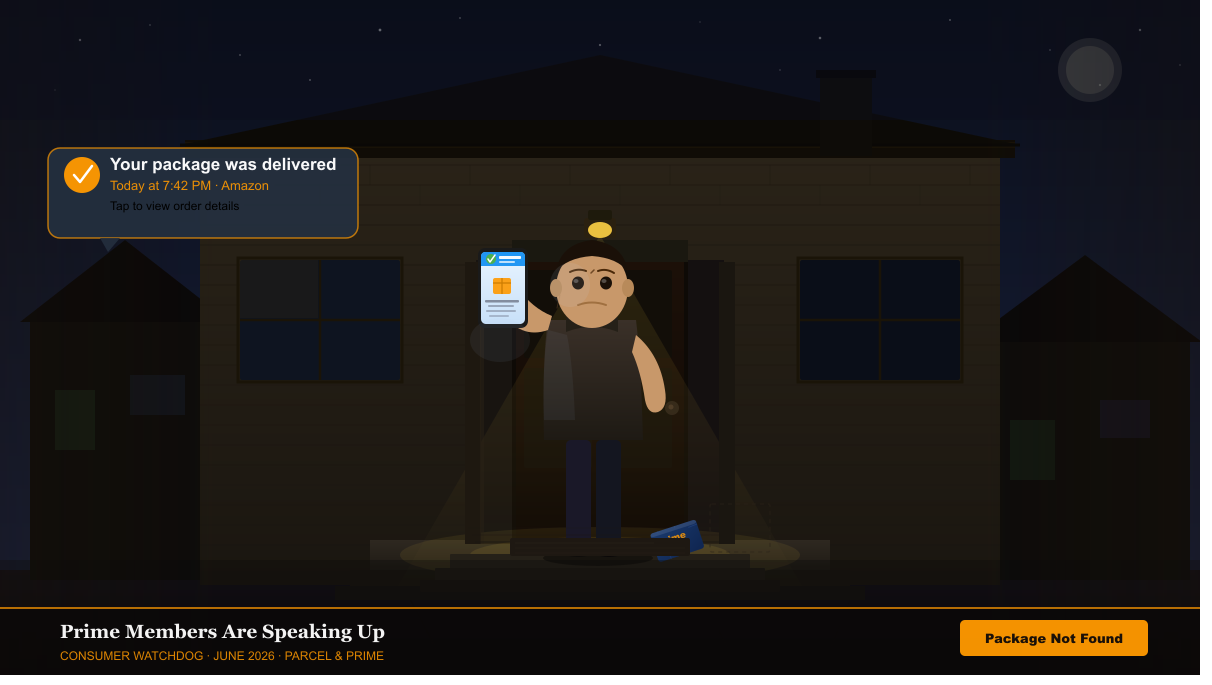
For years, the frustration simmered quietly in subreddit threads and one-star reviews. Now it has boiled over into something Amazon cannot easily ignore: a growing, organized chorus of paying customers who feel the deal they signed up for no longer exists.
There is a particular kind of rage that builds slowly, over years, through a hundred small disappointments.
A package that says “delivered” but never arrives. A movie interrupted by the same car ad four times in a row. A membership that cost $79 a year when you first signed up, now approaching $160, while every renewal seems to strip away another thing you thought you were paying for.
Amazon Prime members know this feeling intimately. And in 2026, they have had enough of swallowing it quietly.
Across Reddit’s r/AmazonPrime, across Trustpilot and X, across neighborhood Facebook groups and small-claims courthouses, something has shifted. The complaints are no longer isolated grievances absorbed into Amazon’s support portal and forgotten.
They are coordinated, loud, and increasingly backed by lawsuits, cancellation waves, and regulatory attention. The people paying $139 a year for a service promise are asking a pointed question: what exactly are we paying for now?
The promise was simple. The execution has not been.
When Amazon launched Prime in 2005, the pitch was almost laughably straightforward: pay a flat annual fee, get fast free shipping. It was a clean transaction. A contract between a company and its customers that felt, for years, like one of the better deals in retail history. You handed over $79, and Amazon handed over certainty. That certainty was the product.
What Prime members are describing today sounds like the slow, deliberate dismantling of that contract. Not all at once, which would have caused a riot, but piece by piece, in increments small enough to survive any individual news cycle. The packaging changed while the label stayed the same.

The delivery failures alone would be enough to generate sustained outrage. But they are only one thread in a much larger unraveling. To understand why Prime members sound angrier in 2026 than they ever have before, you have to look at what has happened to the membership itself over the past four years, because the timeline is genuinely remarkable.
A timeline of a trust deficit
2022
The first price shock
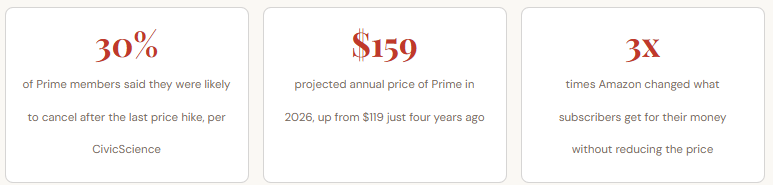
Amazon raised the annual Prime price from $119 to $139, a 17% jump, the first increase since 2018. CivicScience surveyed Prime members immediately after the announcement: 30% said they were likely to cancel. The company kept the money and held the membership base mostly intact, which may have taught the wrong lesson.
January 2024
Ads arrive in the living room, uninvited
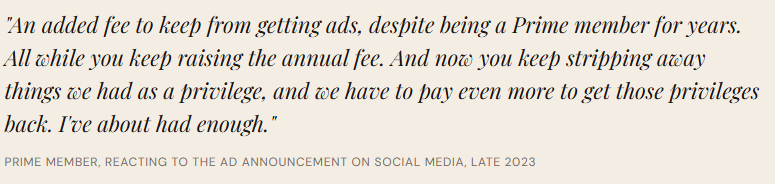
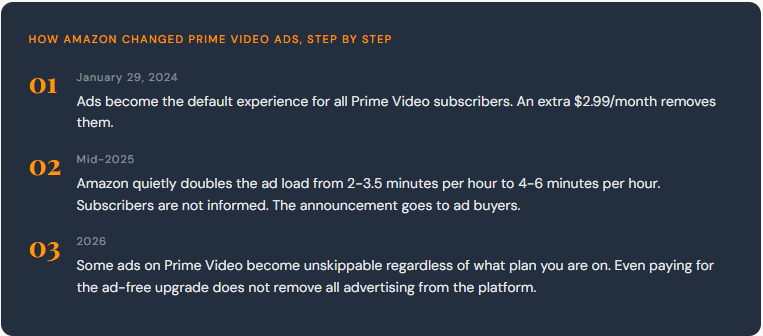
Amazon began running advertisements on Prime Video for all subscribers. The thing that had previously been included in the membership now required an additional $2.99 a month to remove. Members who had paid for ad-free streaming for years suddenly found themselves watching car commercials mid-episode. The backlash on social media was swift and furious.
Mid-2025
The promise about ads gets quietly broken
When Amazon first introduced ads, it promised 2 to 3.5 minutes per hour. By mid-2025, according to an Adweek investigation, that figure had doubled to 4 to 6 minutes per hour. This change was announced to advertisers, not subscribers. The people paying $139 found out when they noticed their shows kept stopping.
2026
Another price increase looms according to analysts
Reports indicate Amazon is expected to raise the annual Prime price again to $159. If accurate, a membership that cost $79 when Prime launched will have doubled in price while the core experience has, by many members’ accounts, deteriorated. The math is not lost on anyone.
The ads problem is bigger than anyone admits
There is something psychologically distinct about being charged to remove something that was not there when you bought the product. It is not the same as a price increase. A price increase asks you to pay more for the same thing. What Amazon has done with Prime Video ads is something different: it has taken something away and then offered to sell it back to you.
The tech analyst community has a word for this pattern, borrowed from biology: enshittification. The platform first serves its users well to grow its base, then it degrades the experience to serve advertisers and shareholders, extracting value from the loyalty it built during the good years.
Amazon has not invented this playbook, but Prime members feel the company has executed it with unusual efficiency given how foundational the membership promise was to the company’s identity.
Also Read: Amazon Customers are Airing New Complaints.
Deliveries: where the frustration becomes personal
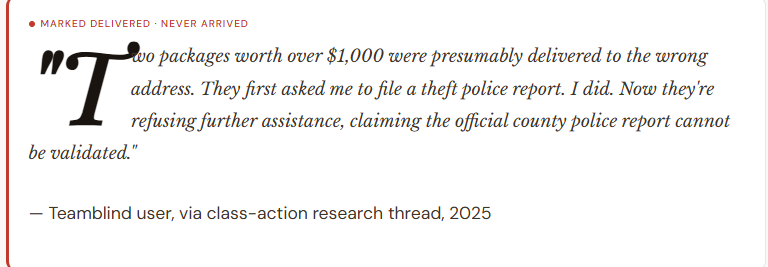
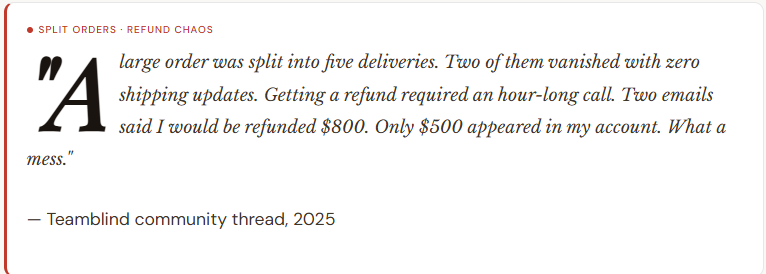
If the streaming issues feel abstract, the delivery failures feel deeply personal. Your package. Your porch. Your birthday gift that shows up four days late. Your $1,000 laptop, marked delivered by a driver who was photographed throwing packages from a moving vehicle. Your refund, promised in two emails for $800, arriving at $500 with no explanation.
The District of Columbia’s attorney general took Amazon to court over delivery discrimination, alleging the company secretly stopped offering its fastest delivery service to two lower-income ZIP codes while continuing to charge the residents full Prime price.
According to the lawsuit, Prime members in the rest of the city received packages within two days about 75% of the time. Those in the excluded ZIP codes received them in two days just 24% of the time. Amazon denied the claims, but the lawsuit’s existence tells you something about where the frustration has traveled: from Reddit threads to courtrooms.
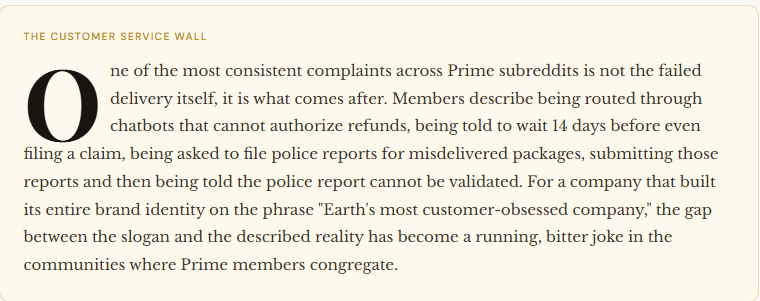
The pattern that emerges from thousands of individual complaints is not random incompetence. It describes a system under pressure: more packages, faster promises, thinner margins on delivery, and a customer service infrastructure that was not built to handle the volume of exceptions that the scale of Amazon’s operation inevitably generates.
The result is a company that can get your package to you in two days on a good day, and that will bury you in process when something goes wrong.
What happens when the loyal customer leaves?
The most underappreciated risk in Amazon’s current situation is not a viral complaint thread. It is the quiet cancellation. The subscriber who does not post anything, does not threaten anything, simply decides one day that the math no longer works and lets the membership expire.
These people do not make the news. They do not appear in subreddit posts. But they represent the slow erosion of something Amazon spent decades building: the habitual Prime member who buys through Amazon first without thinking about it, because the membership makes every purchase feel like it comes with a bonus.
Competitors have noticed the opening. Walmart+ has been expanding aggressively, offering its own version of the Prime bundle at a lower price point. Target’s same-day delivery and drive-up service has pulled shopping volume away from Amazon in suburban markets.
Temu and other ultra-low-price platforms are absorbing the customers who came to Amazon for value and increasingly feel they are not getting it.
None of these competitors has dethroned Amazon yet. The Prime membership base remains enormous and the logistics infrastructure is genuinely formidable.
But the defection is not measured in quarters; it is measured in years. And the current trajectory, price going up, ad load going up, delivery reliability staying inconsistent, customer service staying difficult, is one that a thoughtful company should be very worried about.
The thing about loyalty is that it has a memory
Amazon Prime members are not angry because they hate Amazon. The frustration is more complicated than that, and more dangerous for the company. They are angry because they remember when this was different.
They remember paying $79 a year and feeling like they had discovered something remarkable. They remember two-day shipping being reliable enough to plan around. They remember a streaming service that felt like a bonus, not a battlefield of upsells.
That memory is what gives their complaints their particular sharpness. You do not feel betrayed by a company you never trusted. You feel betrayed by a company you loved, and then watched change, incrementally, in ways that always seemed to benefit the company slightly more than you.
There is a version of this story where Amazon course-corrects. Where the volume of complaints translates into internal pressure to fix delivery reliability, simplify the refund process, and rethink the ad strategy for a paying subscriber base.
That version is still possible. But the version that Prime members are describing in their posts and reviews and lawsuits, the version where every year the price goes up and every year something else is taken away, that version is running out of goodwill to spend. And goodwill, unlike a Prime membership, does not auto-renew.
We have enabled comments. Please let us know your thoughts down below. We would also appreciate it if you widely shared this article using the share buttons below. That way, we’ll reach more Prime Users.