New consumer data reveals a surprising bright spot: when the postal service handles the last mile for Amazon orders, shoppers tend to walk away happier, and the numbers tell a compelling story.
There is a certain satisfaction that comes with a package landing on your doorstep ahead of schedule. You ordered something on Tuesday afternoon, and by Thursday morning, it is already there, waiting for you.
No drama. No tracking anxiety. Just a box. But researchers who study what drives customer happiness in e-commerce are finding that who carries that package to your door matters more than most shoppers realize.
New findings from the American Customer Satisfaction Index (ACSI) Retail and Consumer Shipping Study 2026, which surveyed tens of thousands of U.S. consumers over the course of 2025, point to a clear link between on-time delivery and the kind of post-purchase satisfaction that keeps shoppers coming back.
And tucked inside that data is an interesting thread: USPS, the carrier that most Americans grew up with, has quietly been delivering stronger results for Amazon orders than its reputation might suggest.
What the research actually shows
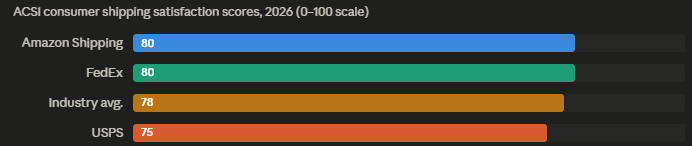
The ACSI’s 2026 study, released in January of this year, found that consumer satisfaction with shipping overall ticked up 1% to a score of 78 out of 100.
That gain was fueled in large part by measurable improvements in two specific areas: delivery timeliness and how easy it is to track a package. Both are areas where USPS has been pouring investment, and both are things Amazon shoppers care deeply about.
The USPS scored a flat 75 on the ACSI scale for 2026, which does not sound thrilling until you consider what has been happening behind the scenes.
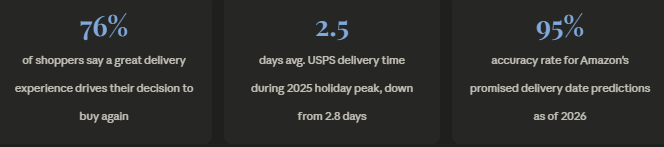
According to a January 2026 report from USPS headquarters, the postal service delivered 16 billion mail items and packages during the 2025 holiday season in an average of just 2.5 days.
That compares to 2.8 days during the same window the year before. On-time delivery rates improved across virtually every product category, with the best scores coming in from last-mile delivery units, which is exactly where the Amazon-to-doorstep handoff happens.
“These results reflect the tenacity of our workforce as well as the network improvements we continue to implement.”
That quote comes from USPS Postmaster General David Steiner, speaking about the agency’s 2025 holiday performance, and it is hard to dismiss. The postal service processed 16 billion items in that period alone, and the needle on customer complaints moved noticeably downward, per the USPS Office of Inspector General.
Why the carrier connection matters more than you think
Sifted’s 2025 consumer survey, which polled 500 shoppers across the United States, put the stakes plainly: 76% of people said a positive delivery experience directly influenced their decision to purchase from that retailer again.
That figure climbed from 72% the year before. The same research found that 53% of consumers said having multiple shipping choices, including different carriers and speed tiers, made them more likely to complete a purchase in the first place.
That context matters for Amazon specifically. The company now delivers more packages than any other carrier in the country, surpassing USPS’s own volume for the first time in 2025, with Amazon Logistics handling 6.7 billion packages compared to USPS’s 6.6 billion, according to ShipMatrix.
But Amazon still routes a substantial portion of its orders through USPS, particularly for rural and suburban destinations where postal carriers have built up decades of route familiarity. Sunday deliveries for Prime orders, in particular, lean on USPS’s reach.
When those handoffs go well, and increasingly they are, customers tend to rate the experience highly. The reasoning is intuitive once you hear it: USPS carriers know their routes. In many neighborhoods, the letter carrier is not a stranger.
There is a baseline of trust that private logistics services are still working to establish in certain communities, and that familiarity translates into confidence that a package left on the porch will be safe, and that a promised delivery date actually means something.
The tracking factor
One of the clearest findings in the ACSI data is how much tracking visibility has come to shape how customers feel about a delivery, regardless of which carrier handles it.
The 2026 study specifically called out improvements in ease of shipment tracking as a driver of the industry’s overall satisfaction gain, and USPS’s Informed Delivery program is a direct contributor to that trend.
Internal USPS surveys for the April 2024 through March 2025 period showed that 94% of Informed Delivery users reported being satisfied or very satisfied with the feature.
Another 93% said they would recommend it to others. When a customer can see a digital preview of what is coming and roughly when, the anxiety of waiting dissolves. The package is no longer a mystery. And when it shows up on time, the overall experience lands as a small but genuine win.
Amazon’s own predictive engine has sharpened over the same period. As of 2026, Amazon’s delivery estimate accuracy sits at 95%, meaning that when it promises a delivery date, it delivers on that promise 19 times out of 20.
For Prime members, the numbers are even better. Over 8 billion items were delivered same-day or next-day to U.S. Prime members during 2025 alone, a 30% jump from the prior year. When USPS is part of that chain and hits its window, the system works exactly as customers hope it will.
A reputational shift in progress
None of this means USPS has fully turned the corner. The OIG’s report on 2025 holiday performance noted that only Ground Advantage, one of USPS’s newer products, actually hit its internal performance target.
Priority Mail and others improved, but still came up short of their benchmarks. There is real work left to do.
But the direction of travel is clear. The postal service that many Americans once associated with long lines, missed deliveries, and general frustration is, by measurable metrics, performing better.
For Amazon shoppers, that improvement shows up as a package that arrives when it is supposed to, handled by a carrier they recognize, tracked by an app that actually updates. It is not a dramatic story. It is just a good delivery, and apparently, good deliveries make people meaningfully happier.
The ACSI has been tracking customer satisfaction for over 25 years, and its core insight has never changed: the gap between what customers expect and what they actually experience is what satisfaction is made of.
Right now, for a growing number of Amazon customers whose packages travel the last mile in a USPS truck, that gap is closing.