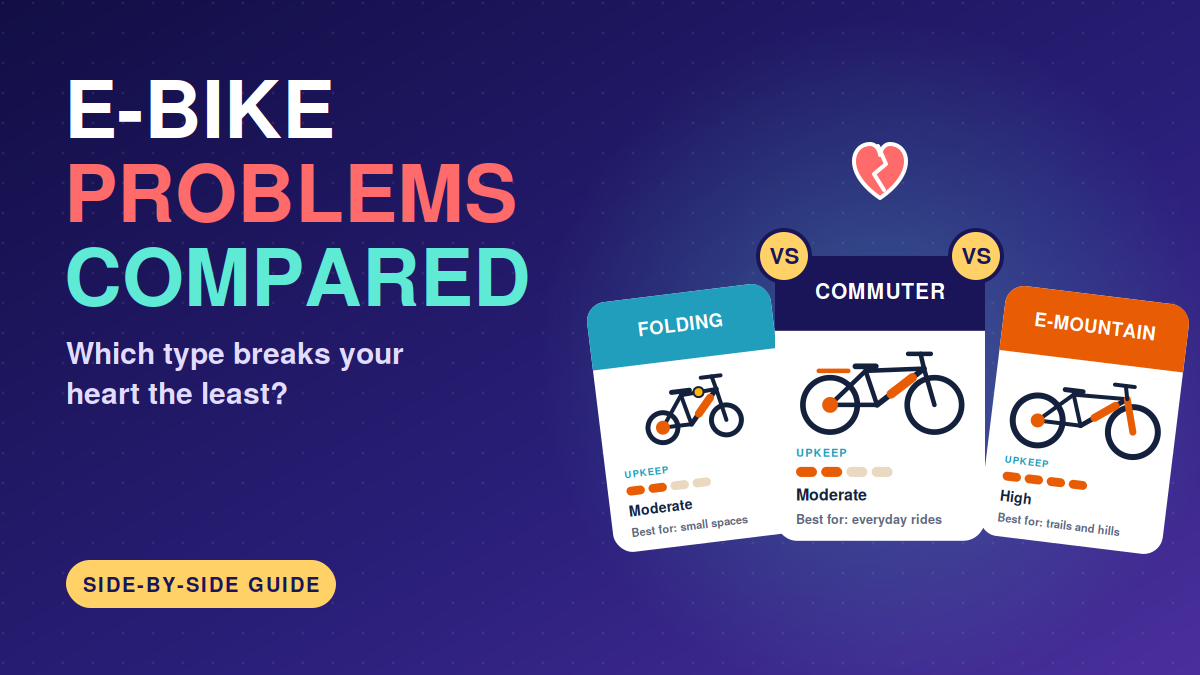
Picture the dating profiles.
The commuter e-bike: “Reliable, practical, loves early mornings.” The folding e-bike: “Small, flexible, easy to take anywhere.” The mountain e-bike: “Adventurous, powerful, a little high maintenance.” The cargo e-bike: “Can carry all your baggage. Literally.”
Everyone looks perfect on the first date. The real test comes six months in, when you learn who squeaks when it rains, who gets moody in the cold, and who goes quiet when you need support.
This guide puts every major type of electric bike side by side and compares the problems they tend to develop. The aim is not to scare you away from e-bikes. It is to help you pick the one whose flaws you can live with, because every e-bike has some.
The Ground Rules for a Fair Comparison
Before the head-to-head rounds, a few honest notes.
- Problems vary more by build quality than by bike type. A well-made folding bike can outlast a poorly made commuter.
- Riding style matters as much as the bike. Rider weight, terrain, weather, and maintenance habits change everything.
- These are general tendencies. They come from how these designs work and from the kinds of issues owners commonly report, not from a lab test of any one model.
With that settled, let’s meet the contenders.
Round 1: Bike Type vs. Bike Type
Commuter and City E-Bikes
Typical strengths: Comfortable, practical, often with fenders, lights, and racks built in.
Common problems:
- Drivetrain wear from daily stop-and-go riding
- Brake pad wear in traffic
- Accessory trouble, such as loose racks, rattling fenders, and failing lights
- Water exposure from year-round use, which stresses connectors and displays
The bottom line: Few dramatic failures, but lots of small ones from heavy daily use. Maintenance is the price of reliability.
Folding E-Bikes
Typical strengths: Compact, easy to store, handy for mixed commutes.
Common problems:
- The hinge: It can loosen over time and may develop play or creaks
- Small wheels: They take bumps harder and can feel twitchy at speed
- Tyre wear: Smaller tyres rotate more often and may wear faster
- Battery and motor strain: Compact frames leave less room for cooling and cable routing
- Weight surprise: “Folding” does not mean “light” when a motor and battery are on board
The bottom line: The folding mechanism is the thing to inspect closely. Check it regularly and never ignore a loose hinge.
Electric Mountain Bikes (eMTB)
Typical strengths: Powerful motors, strong brakes, and rugged frames.
Common problems:
- Heavy drivetrain wear: Torque and dirt chew through chains, cassettes, and chainrings
- Suspension upkeep: Forks and shocks need regular servicing
- Brake fade: Long descents can overheat brakes and wear pads fast
- Moisture and mud: Constant exposure stresses seals, bearings, and connectors
- Crash damage: Falls can hurt motors, displays, and batteries
The bottom line: Very capable, but expect higher maintenance costs and more frequent servicing.
Cargo E-Bikes
Typical strengths: Can carry children, groceries, or equipment.
Common problems:
- Brake and tyre wear: Extra load makes both work harder
- Frame and wheel stress: Heavy loads strain spokes, hubs, and frame joints
- Battery drain: Hauling weight cuts range sharply
- Storage and handling: Their size makes parking, stairs, and tight spaces difficult
- Parts availability: Specialized parts can be harder to find locally
The bottom line: Fantastic for the job, but inspect wheels and brakes often, and plan for storage before you buy.
Fat-Tyre E-Bikes
Typical strengths: Great traction on sand, snow, and rough ground.
Common problems:
- Very high weight
- Heavy wheels that make punctures and tyre swaps harder
- Reduced range from rolling resistance
- Heavier stress on motors and drivetrains
The bottom line: Fun and capable, but you pay in weight and energy use.
Speed Pedelecs and High-Performance Commuters
Typical strengths: Higher assisted speeds and longer commutes.
Common problems:
- Faster wear on tyres, brakes, and chains
- Higher battery demand
- Stricter rules in many places on where and how they can be ridden, and sometimes on registration or insurance
The bottom line: Check your local regulations before buying one, and budget for faster-wearing parts.
Round 2: Hub Motor vs. Mid-Drive Motor
This is one of the biggest comparisons in the e-bike world, and each has its own personality.
| Feature | Hub Motor | Mid-Drive Motor |
|---|---|---|
| Location | In the wheel hub | At the crank, near the pedals |
| Common problem | Less natural feel on steep climbs, harder wheel removal | Faster chain and cassette wear |
| Repair complexity | Often simpler for the motor, trickier for the wheel | More complex, often needs specialist tools |
| Weight balance | Weight at one wheel | Weight low and central |
| Flat tyre difficulty | Often harder because of the motor and cable | Usually easier |
| Best for | Budget-friendly, flat to moderate terrain | Hills, a natural pedalling feel, and heavy loads |
Verdict: Neither is “better” overall. Hub motors tend to be simpler and cheaper, while mid-drives tend to handle hills more gracefully but ask more of your drivetrain.
Round 3: Budget vs. Mid-Range vs. Premium
Price changes the kind of problems you meet more than the number of problems.
Budget e-bikes:
- Often have weaker brakes and basic components
- Batteries and electronics may be harder to replace
- Support and parts availability can be inconsistent
- Assembly quality may vary
Mid-range e-bikes:
- Usually have better brakes, drivetrains, and batteries
- Typically more consistent quality control
- Better chance of reliable support and parts
Premium e-bikes:
- High-quality components and refined electronics
- Strong dealer networks in many cases
- But proprietary parts can make DIY repairs harder, and servicing can be expensive
Verdict: The sweet spot for most riders is a mid-range bike from a brand with solid support. Spending more helps most when it buys you service, parts, and better components, not just a nicer badge.
Round 4: Battery Design Comparison
How the battery is built into the bike affects how it fails.
| Battery Style | Strengths | Common Problems |
|---|---|---|
| Integrated into the frame | Clean look, protected from the weather | Harder to remove, replace, or charge off the bike |
| Mounted on the down tube | Easy to remove and charge | Exposed to splashes and knocks |
| Rear rack mounted | Simple, often swappable | Can affect handling and add rear weight |
Verdict: If you charge at a desk or need to carry the battery upstairs, a removable design saves daily frustration.
Round 5: Brake and Drivetrain Choices
Mechanical disc brakes vs. hydraulic disc brakes:
- Mechanical brakes are simpler and easier to adjust, but they need more hand effort and frequent tweaking.
- Hydraulic brakes feel stronger and smoother, but they may need professional bleeding when they get spongy.
Chain drive vs. belt drive:
- Chains are common, cheap, and easy to replace, but need regular cleaning and lubrication.
- Belts are clean and quiet and can last a long time, but they require compatible frames and are harder to source in a hurry.
Verdict: For heavier or faster e-bikes, hydraulic brakes are generally worth having. For low-maintenance commuting, a belt can be a pleasant upgrade if parts and service are available near you.
Round 6: Direct-to-Consumer Brand vs. Local Dealer
This is a comparison of what happens after the sale.
| Factor | Online Direct Brand | Local Dealer Brand |
|---|---|---|
| Price | Often lower | Often higher |
| Assembly | You or a shop do it | Usually done for you |
| Repairs | May require shipping parts or the bike | Often handled in person |
| Warranty claims | Can be slower, depending on the company | Often more hands-on |
| Test rides | Rare | Common |
Verdict: Direct brands can offer great value, but only if they have clear warranty terms and responsive support. A local dealer’s real value is the person you can walk up to when something goes wrong.
The Master Comparison Chart
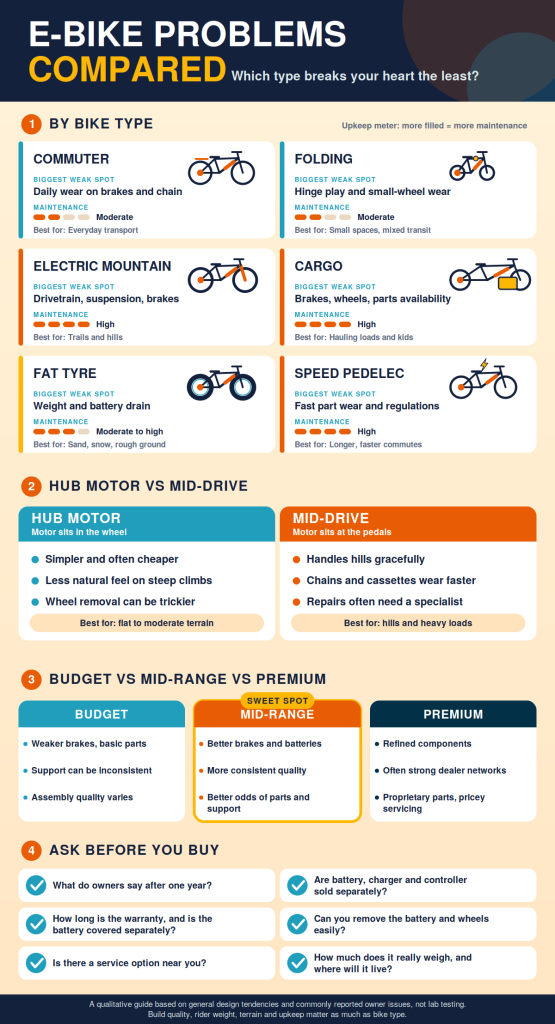
| Bike Type | Biggest Typical Weak Spot | Maintenance Level | Best For |
|---|---|---|---|
| Commuter | Daily wear on brakes and chain | Moderate | Everyday transport |
| Folding | Hinge play, small-wheel wear | Moderate | Small spaces, mixed transit |
| eMTB | Drivetrain, suspension, brakes | High | Trails and hills |
| Cargo | Brakes, wheels, parts availability | High | Hauling loads and kids |
| Fat tyre | Weight and battery drain | Moderate to high | Sand, snow, and rough ground |
| Speed pedelec | Fast part wear, regulations | High | Longer fast commutes |
Which Problems Matter Most to You?
Match the weak spot to your life.
- If you commute daily in all weathers: Prioritize water protection, quality brakes, and a bike with easy-to-find spare parts.
- If you live in an apartment: Prioritize a removable battery and a manageable weight.
- If you ride hilly terrain: Look at mid-drive motors and strong hydraulic brakes.
- If you carry kids or cargo: Look hard at brake quality, wheel strength, and service availability.
- If you want the lowest hassle: Choose a simpler design from a brand with excellent support rather than the most feature-packed bike.
A Quick Pre-Purchase Comparison Checklist
When you are choosing between two or three bikes, put each through the same questions.
- What do owners report after one year of use?
- Are battery, charger, display, and controller available as spare parts?
- How long is the warranty, and does the battery have its own terms?
- How easy is it to remove the battery and wheels?
- Is there a service option near you?
- What does the brand say about weather resistance, and do owners agree?
- How much does the bike actually weigh, and can you handle that weight in your daily life?
The bike with the best answers usually wins, even if it loses on specs.
Frequently Asked Questions
Which type of electric bike has the fewest problems?
There is no single winner. Simpler designs, such as hub-motor commuters from reputable brands, often have fewer complex issues, but build quality and support matter more than category.
Are mid-drive e-bikes more reliable than hub motors?
Not necessarily. Mid-drives are often smoother on climbs but tend to wear drivetrains faster. Hub motors are simpler but can feel less natural on hills.
Do folding e-bikes break more often?
They have an extra point of wear in the hinge, and smaller wheels can feel harsher, but a well-made folding bike that is checked regularly can be reliable for years.
Is a pricier e-bike always better?
Not always. A higher price often buys better components and support, but it can also mean proprietary parts. Look at what the extra money is actually paying for.
Which e-bike is cheapest to maintain?
Generally, simpler commuters with standard parts are cheaper to maintain than eMTBs, cargo bikes, or speed pedelecs, which put more stress on components.
What should I compare first when choosing between two e-bikes?
Compare warranty terms, parts availability, and service support before you compare specs. Those decide how painful a problem will be if one shows up.
The Final Verdict
If you are hoping to find the e-bike with no problems, you will be searching forever. A better plan is to find the one with the problems you can handle: a hinge you will check, a chain you will clean, a battery you will carry, or a brand you can actually reach.
Compare honestly, ask about the boring things like parts and service, and choose the bike whose flaws fit your life. That is the one you will still be riding, and still enjoying, long after the first date glow has faded.