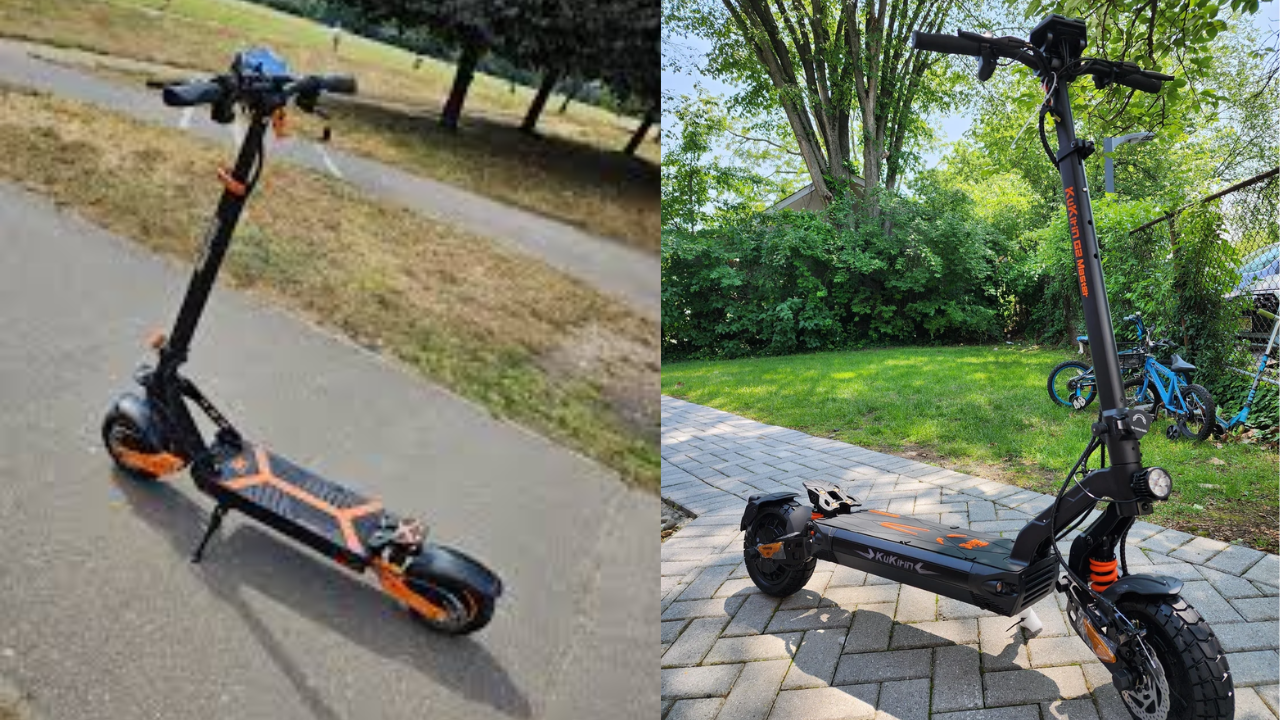
If you’ve narrowed your search to the Kukirin G2 Max and G2 Master, you’re already looking at two of the strongest electric scooters in the mid-to-premium segment.
They share the same DNA: identical battery capacity, the same tire size, and the same overall platform, yet they ride very differently in the real world.
This guide cuts through the spec-sheet noise with verified manufacturer data, independent test results, and our real user feedback to help you make the right call.
Whether you’re a daily urban commuter or someone who wants a capable off-road machine, the answer depends on a few key factors we’ll break down fully.
Quick Verdict
| Who it’s for | Best pick |
|---|---|
| Long-distance commuters, urban riders, value seekers | G2 Max |
| Hilly terrain, off-road adventure, max performance | G2 Master |
Full Specifications Side-by-Side
| Specification | G2 Max | G2 Master |
|---|---|---|
| Motor | 1000W rated (1200W peak) | Dual 1000W (1200W peak each) |
| Total Power | 1000W / 1200W peak | 2000W / 2400W peak |
| Battery | 48V 20.8Ah | 52V 20.8Ah |
| Top Speed | 55 km/h | 60 km/h |
| Claimed Range | ≤70 km | ≤70 km |
| Climbing Ability | ≤22° | ≤28° |
| Tires | 10-inch pneumatic | 10-inch pneumatic |
| Brakes | Front & rear disc + e-brake | Front & rear disc + e-brake |
| Suspension | Front & rear spring | Front & rear hydraulic |
| Display | LCD (133×76mm) | LCD with dual-drive indicator |
| Drive Modes | Single rear drive | Single OR dual drive (switchable) |
| Weight | 31.72 kg | 33.5 kg |
| Water Resistance | IP54 | IPX4 |
| Seat Included | Yes (kit included) | Yes |
Motor & Performance: The Single Biggest Difference
This is where the two scooters diverge most sharply.
The G2 Max runs a single 1000W rear hub motor (peaking at 1200W). In real-world testing, it reaches approximately 40–41 km/h on flat ground and climbs gradients up to 22°.
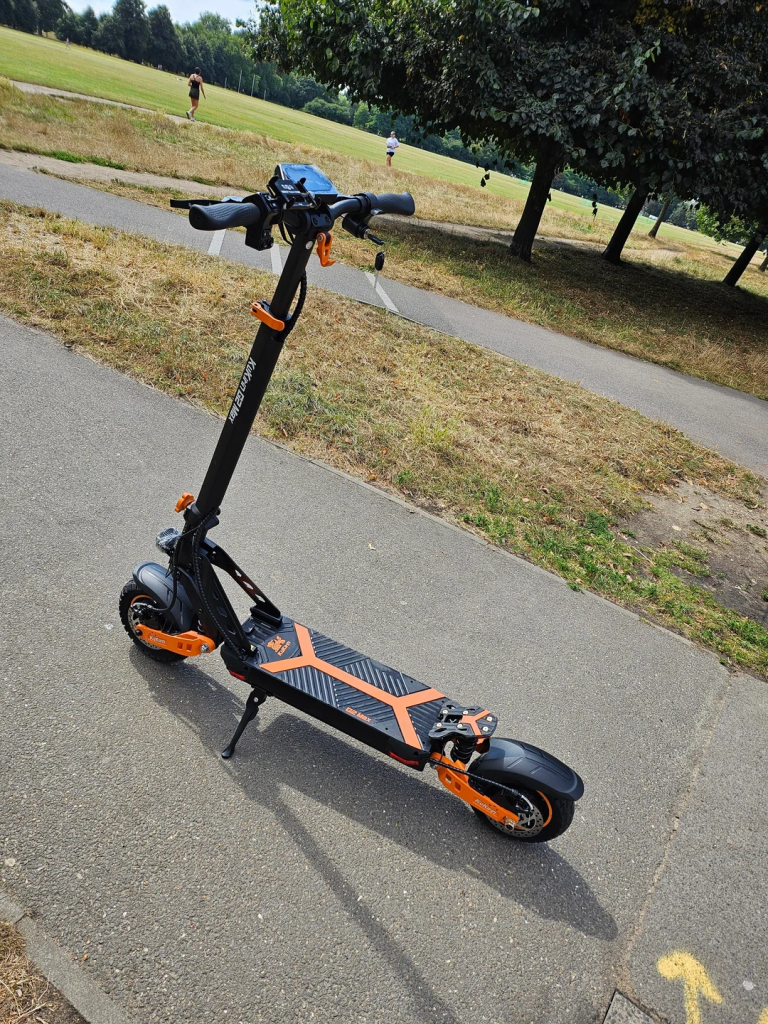
For most urban riders, this is genuinely more than enough. Reviewers who tested the scooter on mixed urban routes found the acceleration smooth and consistently strong.
The G2 Master runs dual 1000W motors; one front, one rear, for a combined 2000W rated output (peaking at 2400W). That’s not just doubled power: the front-and-rear drive configuration fundamentally changes traction and hill-climbing behavior.
Independent testers noted the torque delivery is immediate and forceful when both motors are engaged, allowing the scooter to tackle 28° inclines; steep enough to match most city hills, without losing composure. One reviewer described the first dual-motor throttle pull as genuinely surprising: acceleration that builds fast and stays strong all the way to its 60 km/h ceiling.
The G2 Master also offers switchable single/dual drive modes. Riders can cruise on one motor for daily errands to conserve battery, and switch to dual drive for hills, headwinds, or heavier loads. This flexibility is a meaningful practical advantage.
Bottom line: If your commute is mostly flat or gently rolling, the G2 Max’s motor is sufficient and efficient. If you face steep hills, carry heavier loads, or simply want the strongest acceleration in the lineup, the dual-motor G2 Master is in a different class.
Battery & Real-World Range
Both scooters share the same 20.8Ah battery capacity, but the voltage differs; 48V on the G2 Max vs. 52V on the G2 Master. The higher voltage on the Master feeds the dual-motor system more effectively, supporting its greater peak power without sacrificing range.
Official claimed range for both is ≤70 km. In practice, real-world range is always shorter:
G2 Max real-world range:
- A 12 km daily commute (mixed flat + 22° hill, standard speed mode) used only 20–25% of the battery per day, meaning a charge every 4–5 days for short commuters.
- A 24 km daily commute with hills brought the battery to 55% after two days of riding.
- A 32 km round-trip at higher speed drained roughly 75% of the battery.
- Realistic range in mixed conditions falls between 40–55 km depending on speed, rider weight, and terrain.
G2 Master real-world range:
- In mixed riding conditions, real-world range typically falls between 48–62 km.
- Running both motors constantly draws the battery down faster; riders who use single-motor mode for flat stretches and dual-motor for hills report range closer to the higher end of that window. We don’t recommend riding in single-motor mode on dual electric scooters, though as you would basically be straining the active one, which can get it beat faster.
For riders whose round-trip is 30 km or under, either scooter will comfortably complete a full day on a single charge with range to spare.
Charging: The G2 Max uses a 54.6V / 1092W charger and takes approximately 10–11 hours for a full charge. The G2 Master has a similar charge window. Planning an overnight charge removes any daily scheduling concern.
Also Read: Kukirin G2 Max vs G2 Ultra
Suspension & Ride Comfort
This is a meaningful upgrade point between the two models.
The G2 Max uses front and rear spring suspension. It’s a solid, proven setup that handles city streets, light cobblestones, and smooth off-road tracks well. Multiple testers described the ride quality as smooth and comfortable for urban use.
The G2 Master upgrades this to front and rear hydraulic shock absorbers. Hydraulic damping absorbs and disperses vibration through fluid compression, reacting dynamically to road conditions rather than at a fixed spring rate.
In practical terms, this matters most on rough roads, gravel, or uneven trails, surfaces where the G2 Master is more likely to be used given its dual-motor capability. Riders testing the G2 Master on off-road surfaces, such as gravel, sand, forest paths, reported a notably smooth, controlled feel with minimal rider fatigue.
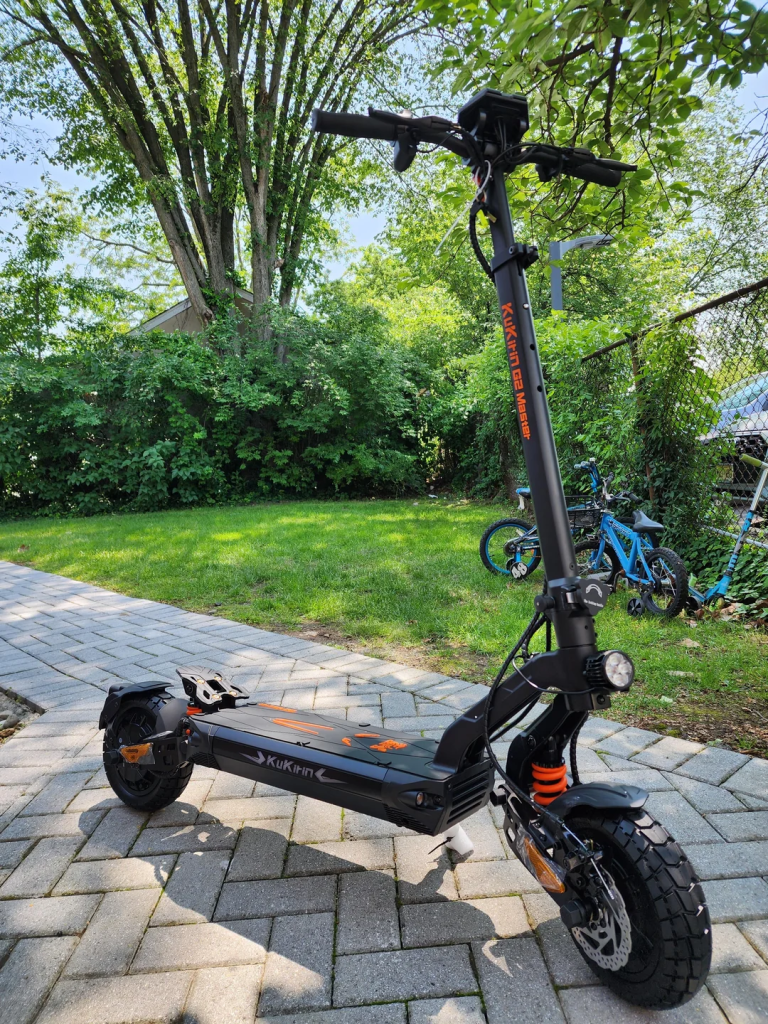
If you’re staying on paved roads, the G2 Max’s spring suspension is completely adequate. If you’re mixing on off-road or heavily potholed city roads, the G2 Master’s hydraulic system is a genuine upgrade.
Build Quality & Weight
Both scooters are built from aluminum alloy frames. These are solid, with no plastic flex or rattling reported in independent reviews. The folding mechanism on both uses a sturdy clamp system that locks securely.
Weight is a practical consideration: the G2 Max weighs 31.72 kg and the G2 Master weighs 33.5 kg. Neither is light, and these are not scooters you’d want to carry up several flights of stairs daily. If portability is a priority, both sit in the “park it and lock it” category rather than “carry it on the subway.”
One important difference: the G2 Max carries an IP54 water resistance rating, meaning it’s protected against dust ingress and water splashed from any direction.
The G2 Master carries IPX4, which protects against splashing water but offers less dust protection. For commuters who ride in light rain, the G2 Max’s rating is slightly better. Neither should be ridden through standing water or heavy downpour.
Display & Controls
The G2 Max features a 133×76mm LCD display showing speed, battery level, trip data, and ride mode. It’s clear and informative.
The G2 Master upgrades to a wider LED display with an additional dual-drive indicator, so you can see at a glance whether you’re running on one or both motors. The display also shows more detailed vehicle information pages. Both units have turn signals, front LED headlights, and brake lights as standard.
Who Should Buy the G2 Max?
The G2 Max is the right scooter if:
- Your daily commute is mostly flat or mildly hilly urban terrain
- Range is more important than raw power. The single motor draws less current, marginally extending battery life per charge cycle
- You ride in variable weather and value IP54’s stronger dust/water protection
- Budget matters. The G2 Max is typically priced lower than the G2 Master
- You want a capable, comfortable all-rounder without over-engineering your ride
Real-world feedback from G2 Max owners points to high satisfaction for exactly this use case: reliable, smooth, strong enough for nearly everything a daily commuter faces.
Who Should Buy the G2 Master?
The G2 Master is the right scooter if:
- You regularly face steep hills (above 20°) that would strain a single-motor scooter
- You ride off-road or on rough, uneven surfaces and want the hydraulic suspension’s real-world benefit
- You want the fastest scooter in the G2 lineup: 60 km/h vs. 55 km/h may seem small, but the dual-motor acceleration to get there is noticeably stronger
- You carry heavy loads or are a heavier rider: dual-motor traction maintains consistent performance where a single motor may bog down
- You want the flexibility to conserve battery on easy stretches and unleash full power on demand
The G2 Master’s dual-motor setup has been described as essential rather than optional for riders in hilly cities; not a luxury feature, but a functional necessity for consistent, safe performance on challenging terrain.
Also Read: Kukirin G2 Max Error Codes Explained
G2 Max vs G2 Master: Key Trade-offs at a Glance
| Factor | G2 Max | G2 Master |
|---|---|---|
| Hill climbing | Good (22°) | Excellent (28°) |
| Acceleration | Smooth, adequate | Punchy, immediate |
| Suspension | Spring (urban-tuned) | Hydraulic (versatile) |
| Water resistance | IP54 (better) | IPX4 |
| Weight | 31.72 kg | 33.5 kg |
| Price | Lower | Higher |
| Dual drive | No | Yes (switchable) |
| Best terrain | Urban / paved | Urban + off-road / hills |
Common Questions
Can the G2 Master be ridden in single-motor mode like the G2 Max? Yes. The G2 Master’s single/dual drive switching lets you ride on one motor for everyday use, matching the G2 Max’s riding profile while keeping dual-motor performance available when needed.
Is the real-world range actually 70 km? No, for either model, 70 km is an ideal-conditions figure. Realistic range is 40–55 km for the G2 Max and 48–62 km for the G2 Master under typical mixed-use conditions. Rider weight, speed, and terrain all affect this significantly.
Which is better for beginners? The G2 Max. Its single motor delivers smooth, progressive acceleration that’s easier to manage. The G2 Master’s dual-motor torque is more abrupt and requires some adjustment, particularly in dual-drive mode.
Are they legal to ride in my country? Electric scooter regulations vary significantly by country and city, particularly around maximum speed limits (many jurisdictions cap legal e-scooter speeds at 25 km/h). Both the G2 Max and G2 Master exceed common legal speed limits in their top speed mode. Check local regulations before purchasing.
Final Recommendation
Choose the G2 Max if you want an efficient, comfortable, range-focused scooter for urban commuting. It handles everything a daily city rider encounters, costs less, and carries better water protection. For most people, it’s the smarter buy.
Choose the G2 Master if you live somewhere hilly, want off-road capability, or simply demand the strongest performance in the G2 lineup. The dual motors, hydraulic suspension, and switchable drive modes turn it into a genuinely versatile machine; one that’s equally at home on a steep city commute and a gravel trail on the weekend.
Both are well-built, well-supported scooters from a brand with a strong track record in the global market. Either choice gets you a serious piece of hardware. The question is just how much of that hardware you actually need.