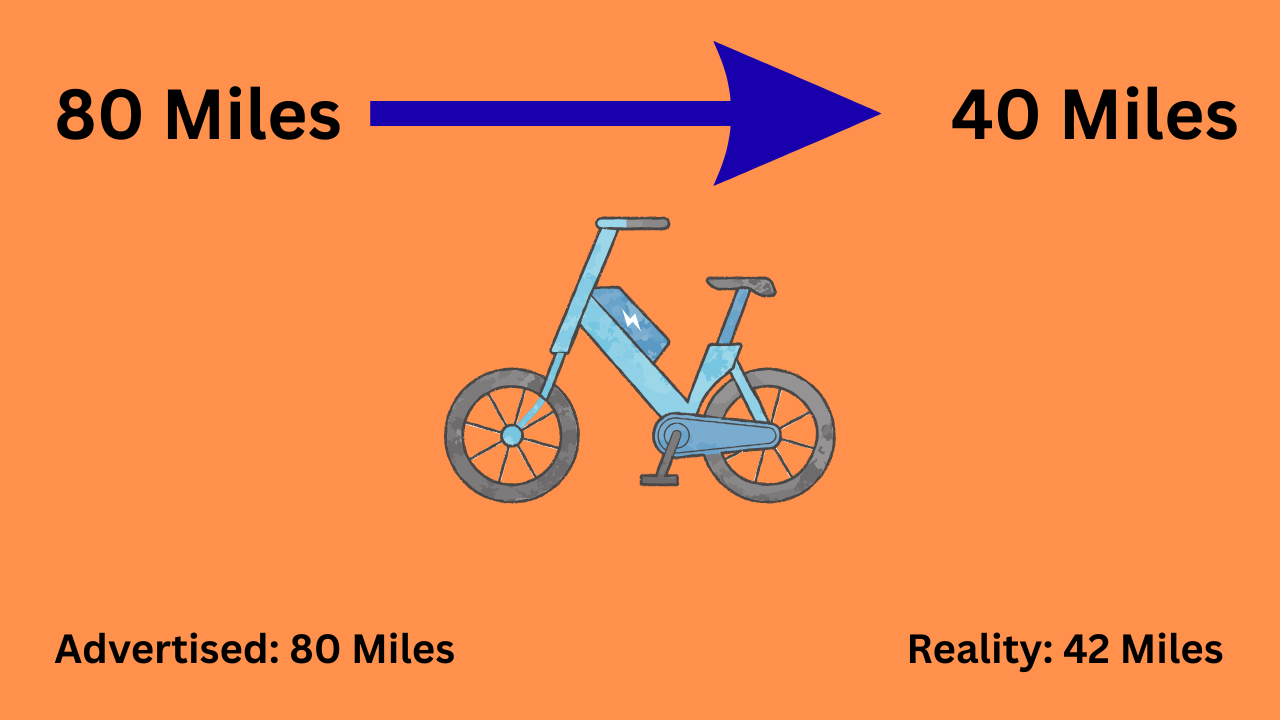
You did your homework. Watched the YouTube reviews. Read the spec sheet. The bike promised 80 miles on a charge. It was enough for your whole commute week, maybe a weekend adventure on the side.
Then you actually rode it. And somewhere around mile 42, the battery icon turned red, and your optimism died with it.
You weren’t cheated, exactly. But you weren’t given the full picture either. Here’s what’s really going on.
The Test That Sets You Up to Fail
When a manufacturer says “up to 80 miles,” they mean it, technically. That number comes from a controlled lab test: a light rider (around 165 lbs), dead-flat pavement, zero wind, lowest possible assist level, steady speed.
Think of it like a car’s official fuel economy rating. It’s a number that exists in a perfect world, posted by people who are legally required to give you a number.
The real world is not that world.
The Fine Print Nobody Reads
Most e-bikes deliver 20–40% less range than advertised under normal riding conditions. In extreme cases: cold weather, heavy rider, hilly terrain, turbo mode, that gap can reach 50% or more.
It’s not a bug. It’s not a lie. It’s the collision of ideal lab conditions with the messy, hilly, windy, stop-and-go reality you actually live in.
“The advertised range is where the story begins. Where it ends depends entirely on you.”
The Six Thieves Stealing Your Miles
Range isn’t killed by one thing. It’s a slow bleed from six different directions, all happening at once.
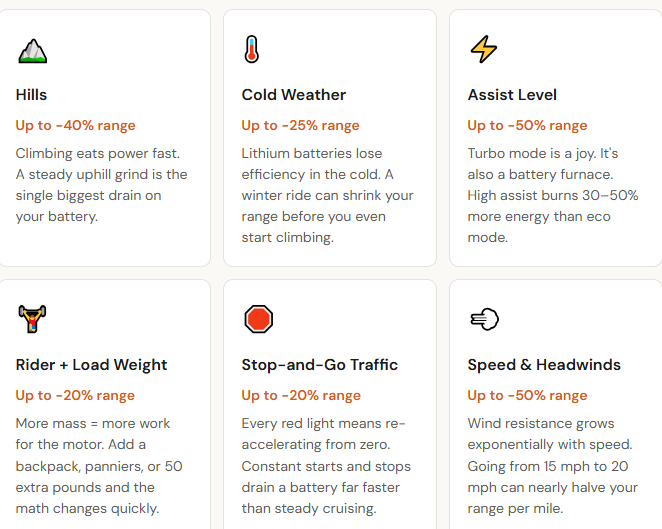
And One More Thief You’re Ignoring
Battery age. That 80-mile promise is for a new battery. After a year of regular riding, your battery’s capacity will have quietly eroded, and the advertised range becomes even more of a fantasy. Most lithium cells lose meaningful capacity within 18–24 months of heavy use, with no warning other than shorter rides.
Two Bikes, Same Battery Size. Very Different Ranges.
Here’s something buyers rarely consider: two bikes can both advertise a 500Wh battery and deliver completely different real-world distances. Cheap battery cells, a dumb battery management system, and an inefficient motor can turn that 500Wh into a 45 km ride. Premium cells with a smart BMS can stretch the same capacity to 70 km. The spec sheet doesn’t tell you which you’re getting.
What You Should Actually Expect
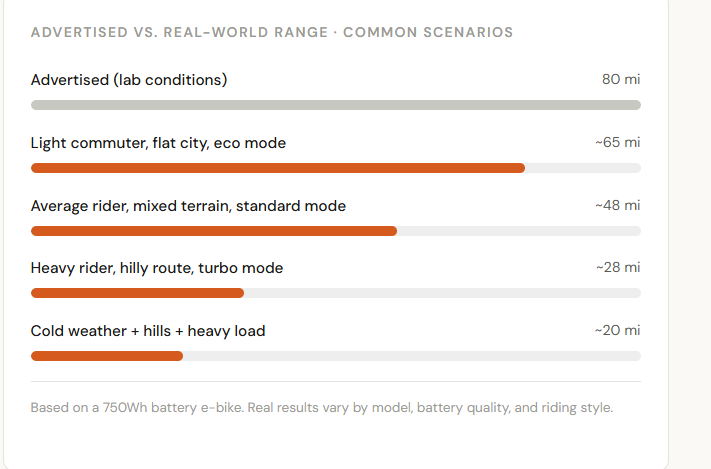
Here’s a more honest framework. For a typical 750Wh battery e-bike:
If you’re a lighter rider on flat urban streets, mostly in eco mode, with mild weather, you’ll likely hit 60–70% of the advertised range. That’s genuinely good.
If you’re an average rider on mixed terrain, using standard assist, with normal conditions, expect 45–60%. This is where most people actually land.
If you’re a heavier rider, regularly climbing hills, using higher assist, in cold weather, plan on 30–40% of what the box says. Possibly less.
The industry rule of thumb is blunt: divide the advertised range by two, and that’s your safe planning number. If that still gets you where you’re going, buy the bike.
Also Read: Why the UL 2849 certification is vital in an ebike
How to Stretch Every Last Mile
- Stay in eco or standard mode until you really need the boost. Resist turbo on flat ground and save it for the hills that actually demand it.
- Keep your tires properly inflated. Soft tires create rolling resistance that quietly bleeds power on every pedal stroke. Check weekly.
- Pedal more, especially from stops. Getting the bike moving is expensive for the battery. If you shoulder some of that effort, the range difference is measurable.
- Don’t store your battery in extreme temperatures. Cold garages and hot car trunks both degrade cells faster. Room temperature is best for storage.
- Slow down a little. Dropping from 20 mph to 16 mph might feel like nothing, but the energy savings are significant. Wind resistance scales with the square of speed.
- Plan routes intelligently. Saving your hills for the end of a ride means riding on a fuller battery when it counts. Your motor works better with more charge.
The Real Question When Buying
Don’t ask: “What’s the range?”
Ask: “What’s the range for someone my weight, on routes like mine, in my weather, at the assist level I’ll actually use?”
That question has no snappy marketing answer. Which is why nobody puts it on the spec sheet. But it’s the only number that matters to you.
Look for independent range tests. Look for reviewers who weigh similarly to you. Check what watt-hours the battery is, not just the miles. And when in doubt, apply the divide-by-two rule before you swipe your card.
Also Read: Funny ebike puns
Bottom Line
E-bike range claims are legal, technically accurate, and practically misleading all at the same time. The 80-mile number exists. You just won’t see it unless you’re riding in a lab. Your real range is shaped by who you are and where you ride, not by what’s written on the box. Know your variables, plan accordingly, and you’ll never be stranded. Ignore them, and mile 42 will find you every time.